It's not a question of if you'll get sick, it's a question of when, how often and how badly. This place seems loaded with evil bacteria just waiting to get into our intestines. There's no avoiding it and there's no getting used to it. In many developing countries, travelers and expats might have a few bouts of what is often called travelers diarrhea (or Moctezuma's Revenge, Delhi Belly, Thai-dal Wave, etc.) but eventually develop an immunity after repeated exposure to bacteria that their system is not used to. There is no immunity to what's in the water here; even Afghans get afghani-sickness.
The basic symptoms of Afghani-sickness are varied because it can be caused by many different things. Abdominal cramping, fatigue, diarrhea, vomiting, nausea, dizziness, bloating, weight loss, infections of the eyes or ears, headaches, fever, body aches . . . any combination of the symptoms.
Some of causes. Afghanistan is plagued with many, many parasitic diseases. If it exists, we probably have it here. Various worms, amoeba, and other fun things like giardia, cholera, e. coli, salmonella, hepatitis are considered "wide spread" in the country. 90% of the water is contaminated due to the non-existent sewage system. Yep, that's right, our water has human and animal waste in it. According to the World Health Organization, Afghanistan's water supply and sanitation are among the lowest in the world (along with several sub-saharan African countries and countries in Southeastern Asia). About 13% of the population has easy access to water (19% in Urban areas, 11% in rural) and only 12% has access to sanitary water (25% urban, 8% rural). The situation can be very depressing.
Now we'll look at prevention. We only drink purified water. We brush our teeth with purified water. All produce we eat goes through an "iodine bath." We soak it in an iodine/water solution for 20 minutes and then rinse it with filtered water. This kills off nasty little things like Hepatitis A and amoebas. All meat must be bought from a reputable source and then washed, cleaned and thoroughly cooked. Milk and yogurt needs to be carefully bought and carefully stored. We buy "Milk-Paks" which are boxes of milk that don't need to be refrigerated until opening. I never open my mouth in the shower and wash my hands religiously throughout the day.
But even with these methods of prevention, sickness will still happen. Our housemate was sick for a month after eating rice from a plate with contaminated meat (she's a vegetarian). Other forms of contracting Afghani-sickness include breathing in contaminated dust, eating after washing your hands and not completely drying them, eating nan (bread) that was sprayed with water to maintain freshness, or sharing a plate of food with someone who hasn't washed their hands with no cutlery (have we mentioned Afghans don't use silverware?).
There are little sicknesses here and there. Unfortunately these days happen often enough that most people continue life as usual within proximity to a bathroom. I've been lucky to have only one seriously sick day (24 hour death virus, I was sure I was on the next med-evac to Dubai but woke up the next day alive, exhausted, but better). I know I will have more and dread their arrival.
Some final words. As I mentioned above, Afghans never get used to all the bacteria and parasites in their country. How awful to think that it could even be possible to get used to drinking fecal matter. The life expectancy for Afghans is around 42 years old. 1 in 4 children die under the age of 5. Although issues like continual war, drought, famine, disease, etc. can all be pointed to for these dismal statistics, the fact is that a lot of Afghanistan's problems have to do with the lack of sanitary water and education on hygiene and contamination prevention. A lot of NGO's focus primarily on water supply, purification and retainment. In many ways they are fighting a losing battle against time and lack of funding. A lot of promises that were made to Afghanistan concerning reconstruction have been forgotten or diverted to other locations.
Showing posts with label adjusting. Show all posts
Showing posts with label adjusting. Show all posts
Monday, September 1, 2008

Friday, August 22, 2008
Dust Storms and Basketball
Living on the other side of the world, we got to watch the USA Men's gold winning performance live without loosing sleep today (basketball and volleyball). The basketball game started at 11:30 AM for us and was just as nerve racking from the all the way in Afghanistan. There are times in life when we realize that we are like our parents. As I paced our lounge for the entire 4th quarter, I suddenly realized, "This is just like my dad. I'm Bill Pandiani." Not that being like my dad is a bad thing. I always remember being in the stands, watching Dad coach basketball while pacing the bench or squatting on the floor. . . Apparently some of that's genetic. And it made me miss that Italian.
But this post isn't about me missing my family, which is setting in more now that I'm realizing we're not visiting Kabul but living here.
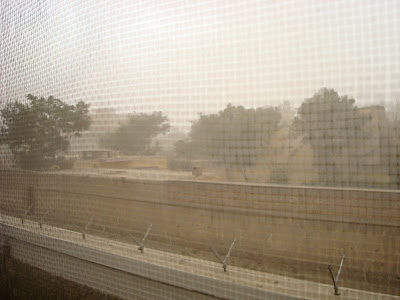
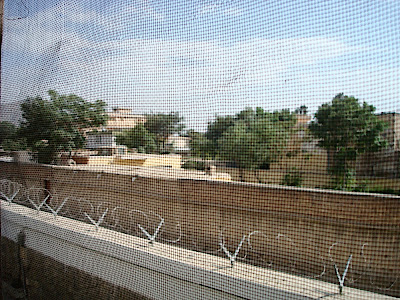
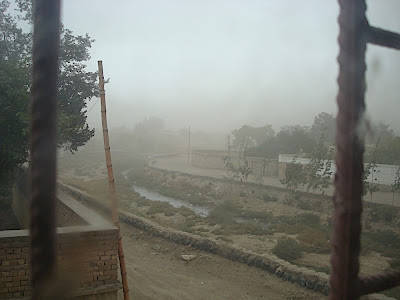
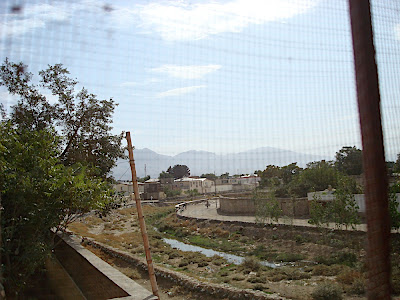
We've officially been Kabul residents for over and month now. I feel like we're both adjusting and that we're starting to feel more at home here. Right now, Joey is kicking the soccer ball around the yard with Gulrahman and I just finished drinking my latte (very home-like things for both of us). An hour ago we couldn't have done either of these things. Right after the games, the power turned off because the generator had run out of water and it suddenly got very, very dark outside. Our clear blue day was gone in seconds with high winds and dust everywhere. Then it started to rain. We quickly shut all the windows which were open because the power was off, although not fast enough to prevent a layer covering on everything in our house. Fast forward an hour later and the generator is fixed, the power is on, my espresso machine is working, and the skies are blue again.
Here are some during and after pictures from the storm:
On our way to our favorite coffee shop this weekend (Thursday-Friday), I was shocked to see an Afghan woman driving a car without a chador. She must have been Afghan-American or something like that because a woman, especially an Afghan, driving a car is unheard of. Going around without a chador can get you deported. I wasn't the only one that noticed as every car that passed slowed to stare.
While watching TV, I felt slightly embarrassed when we flipped past a Indian channel with women doing aerobics in tighter pants and sleeveless tops. Joey and I laughed as we realized that these women would be considered fully dressed in the states and women on TV back home often wear much less.
Although we're getting used to it, sometimes we still can't believe we live here. We went to a friend's house for dinner tonight and while driving home Joey turned to me and said, "Can you believe we really live in Afghanistan?" I think we'll be saying that as long as we live here.
But this post isn't about me missing my family, which is setting in more now that I'm realizing we're not visiting Kabul but living here.
We've officially been Kabul residents for over and month now. I feel like we're both adjusting and that we're starting to feel more at home here. Right now, Joey is kicking the soccer ball around the yard with Gulrahman and I just finished drinking my latte (very home-like things for both of us). An hour ago we couldn't have done either of these things. Right after the games, the power turned off because the generator had run out of water and it suddenly got very, very dark outside. Our clear blue day was gone in seconds with high winds and dust everywhere. Then it started to rain. We quickly shut all the windows which were open because the power was off, although not fast enough to prevent a layer covering on everything in our house. Fast forward an hour later and the generator is fixed, the power is on, my espresso machine is working, and the skies are blue again.
Here are some during and after pictures from the storm:
It's interesting to look at the things that I miss and the things I'm getting used to after just a month of being gone. Like sandwiches, every time we watch an American TV show on DVD it seems like people are eating sandwiches and I want one. Sliced bread is a little hard to find, deli style meat doesn't exist. I also miss "to go" boxes, cups, etc. When Afghans go out to eat, they eat a lot and don't leave much on the plate. I cannot put away a pound of rice in one sitting and wouldn't mind taking some home. But I suppose in a country where little is wasted or thrown away and what is tossed is usually tossed in the river; it's probably a good thing that they don't have to go boxes. Joey misses tamales, tortillas and frijoles negros. And people, we miss people. There are so many incidents, stories and experiences that I want to tell a specific person right way. I find myself thinking "Anya would have died laughing if she saw this," "Ailsa would be infuriated by this," "I want to discuss this with Kristalyn," or the most popular "I could really use a hug from Mary, Sarah, Pam, (fill in name here)."
But despite missing people, we are adjusting and really like it here. Examples of adjustment:
On our way to our favorite coffee shop this weekend (Thursday-Friday), I was shocked to see an Afghan woman driving a car without a chador. She must have been Afghan-American or something like that because a woman, especially an Afghan, driving a car is unheard of. Going around without a chador can get you deported. I wasn't the only one that noticed as every car that passed slowed to stare.
While watching TV, I felt slightly embarrassed when we flipped past a Indian channel with women doing aerobics in tighter pants and sleeveless tops. Joey and I laughed as we realized that these women would be considered fully dressed in the states and women on TV back home often wear much less.
Although we're getting used to it, sometimes we still can't believe we live here. We went to a friend's house for dinner tonight and while driving home Joey turned to me and said, "Can you believe we really live in Afghanistan?" I think we'll be saying that as long as we live here.
Thursday, August 14, 2008
Why blogging in Afghanistan can be difficult
At times I have trouble knowing what to write about on this blog. It's not for lack of material. There is always some new experience, some difference in culture, some adjustment or some piece of news that I itch to share (and sometimes literally itch. Have I mentioned that I am currently waging a war with bed bugs? I'm winning). Afghanistan has a lot going on that I want to write about. The problem is that it is tough to choose what direction to go in. I often find myself sitting at my laptop thinking "Where do I even begin?" Between the new experiences and fun adventures there are a lot of hard topics and frustrating issues. Moving here has put me into a very new context. At times I feel like everything here is completely different. Some of it just takes getting used to (like the call to prayer five times a day) and some of it I don't ever want to get used to (like seeing women ride in the trunk of cars because there isn't room inside the car with the men). I really want people to get an idea of what life is like here, but somedays it seems that there is too much to even give a glimpse. And that's where things get difficult. How do I even begin to show and share this place that is so full of beauty, tragedy, misunderstanding, hopefulness and hopelessness?
My step-lady, Mary, used to make us do this thing at the dinner table to get us to talk about our day. We had to share something funny, sad, good, bad, and beautiful that had happened that day. Alison's were always great. I think that on days when I feel that blogging in Afghanistan is too difficult, f.s.g.b.b. is a good way to share a little about life here. So here it is for today:
Funny: Although streets in Afghanistan don't have names, they are often known by what they sell. Flower Street sells flowers. Chicken Street used to sell chickens, now it's where you go to buy Afghan tourist items. . . business isn't so good right now. Stationary Street sells stationary. Today we ended up on Plumber Street, lots of porcelain and piping.
Sad: There are a lot of beggars in Afghanistan. It's heartbreaking to see women in torn burqas sitting on the side of the road with a hand outstretched. It's heartbreaking to see mine victims with missing limbs begging outside the Red Crescent (Red Cross) offices. It's heartbreaking to see women carrying unconscious children in their arms while they beg and knowing that they probably dropped the child to illicit more sympathy. These are all things I saw today while driving downtown.
Good: Our housemates are great and we are really enjoying sharing an apartment with them. Last night we all sat out and enjoyed the cooler weather and tried to solve the problems of the world (we didn't succeed). Today Sari and I went shopping as we're both in the process of building our Afghan wardrobes. We are so glad that we live and work with people that are laid back and adaptable, just like us.
Bad: On Wednesday, three international aid workers and their driver were killed in the Logar province south of Kabul. The Taliban have claimed responsibility saying they thought it was a military vehicle and that the women were soldiers. The incident has caused increased tension and security within the international community throughout the country.
Beautiful: The dust has settled, the weather has cooled, the sky is blue, and it's supposed to rain tonight! These are beautiful things.
Monday, August 11, 2008
Vocabulary Lesson, Kabul Edition, Issue I.
This is a post that I've been meaning to do for awhile. Some words that are used very frequently in Afghanistan (and in my blog) need further explanation. Here are a list of common terms/places/words mentioned in my blog and their meanings.
Kabul: The capital of Afghanistan. Hopefully you all know that, but we've had people ask.
Dari: A dialect of Persian, spoken in Kabul and most of northern Afghanistan. One of the four official languages
Pashto: The language of the Pashtun tribe, spoken in Kabul and southern Afghanistan, another official languageShalwar Kameez: The traditional clothing of Pakistan worn in many parts of Afghanistan. The style worn in Afghanistan consists of a long shirt with long sleeves and long, loose fitting pants. This is what I usually wear.
Chador, Chadar: The head scarf worn by women when in public. The Afghanistan style covers the head (not face) and upper body.
Burqa: The complete body covering worn by women in Afghanistan over their clothes. It covers the face with a small grill or netting material at the eyes that allows for (limited) vision and air. The burqa was made mandatory by the Taliban and was not used extensively prior to this time. Although the burqa is no longer required it is still worn by many women. Often it is worn to protect personal identity and for security. Burqas are usually light blue, some regions have black or white burqas.
Chakador, chaikador: Doorman/door guard/errand runner. Chakador literally means "Man who sits in chair." We have three different chakadors that work at different times of the week. They are all very nice and we are enjoying getting to know them.
Fixer: Most NGO/Expats have a fixer who does a variety of things for them. Our fixer helps us with driving, phone cards, and other general questions like "What's the best way to get a visa to India?" Or "What is there to do in Mazar-e-Sharif?"
Salaam: Literally, peace. Shortened form of "Salaam Aleikum" (peace be with you). Used as a greeting in Afghanistan.
Tashakor, tashakur: "Thank you" in Dari.
Toshak, toushak: Afghans do not sit on couches, they sit (and often sleep) on toshaks. These are long, flat pillows. They are very comfy.
Seis: Fine or Ok in Dari. We can always tell when an Afghan is ready to end a conversation because they begin to say "seis" repeatedly.
Inshallah: "Lord Willing" Afghans say this whenever talking about plans or the future. Joey and Steve had added it to their pre-flight checklist.
Wednesday, August 6, 2008
Happy Birthday, Afghan style
First of all, Afghans do not celebrate birthdays. We asked our chakador, Gulrahman, how Afghans celebrate their birthdays. He responded, "No, we don't celebrate birthdays. Only births and weddings. But maybe now we should start." This might explain why many Afghans don't know their own age and wrinkle their forehead when you ask and respond, "Hmm...I think....28?"
Yesterday was Joey's birthday. I won't tell you how old, but it's what my Zia Maria called a circle birthday. Although Afghans do not celebrate birthdays, we certainly do. Since I can't drive here and all my options were too far to walk to, I decided to ask our cook, Aga Gul, to bake a cake.
Let me tell you a little about our cook. We really like his food and we really like him. He's a precious old man who speaks very fast, very bad English. I made him a cappuccino last week and he drank it in one giant gulp (Afghans don't drink coffee, Aga Gul has never tasted coffee before) and he proceeded to tell me (I think) that he's really good at sewing buttons on shirts...but then there was something about climbing a hill in the story too, and helicopters...and then he asked if the machine was cheap, from Afghanistan, where coffee came from, and a slew of other questions. When we talk to Aga Gul, we mostly just smile and nod and say thank you.
I went down to the kitchen on Tuesday and found Aga Gul wearing an apron, humming to himself as he wiped down the counters. Here is the conversation that followed:
Julie: Salaam, Aga Gul. How are you today?
Aga Gul: Salaam. Very good. Very nice. Very good. (X5)
Julie: Tomorrow is Joey's birthday. Could you make a cake for him?
Aga Gul: (Long pause, turns and stares at the pantry) I buy vegetables, some spices, (opens freezer) chicken, meat, meat. Tonight I make boulanee (an Afghan pierogie). For tomorrow? Something different?
Julie: Oh, just the cake for tomorrow.
Aga Gul: (Long pause, looks at pantry) Very good. Very nice.
Julie: (Not sure if he understands what I'm saying, but at least I tried) Tashakur, Aga Gul.
At 5:00 on Wednesday, Habib (another chakador) found me and said that Aga Gul had left me a message, "The cake is hidden in the cabinet."
Going out to eat in Kabul is definitely different than going out to eat anywhere else I have been. You don't just walk into any restaurant and sit down. There are three questions asked before going to eat. 1) Is the food safe to eat? As we have mentioned before, it is very easy to get sick here. There are no food sanitation laws in Afghanistan. 2) Is it still open? Due to the situation here, restaurants open, close, move, reopen, etc. 3) Is it secure? This involves not only the security at the restaurant itself, but of the surrounding area and neighborhood. There is a fine balance between going someplace that is too high profile and not secure enough.
We went to a Mexican restaurant called La Cantina. Yes, that's right, there is one Mexican restaurant in Kabul. After three security checks in three separate rooms and finally getting into the restaurant, our time was quite enjoyable. The food wouldn't be termed authentic, more like an interpretation. The beans were delicious, but almost tasted more Indian than Mexican. But it was great to sit outside and laugh and relax with our housemates.
When we returned home, I searched the cabinets to find the hidden cake. Sure enough, Aga Gul had come through with a cake glazed, frosted, and decorated with marshmallows.
The times that I miss friends and family most are the days that are meant to be spent with friends and family. Weddings, important events, birthdays, holidays; these are the times when I know I will feel far away. But last night, sitting around the table with Steve and Sari and Gulrahman, eating cake that was ridiculously sweet and celebrating Joey's circle birthday; I realized that slowly but surely, we're building friends and family here too. I love the line from the Kimya Dawson song, My Rollercoaster, "And if home is really where the heart is, than we're the smartest kids I know. Because wherever we are in this great big world, we'll never be more than a few hours from home."
Monday, July 28, 2008
The Blue Mosque
There are not many tourists in Afghanistan. When I emailed someone that we were going sightseeing they responded, "Can you do that in Afghanistan?" Apparently the answer is yes because on our first full day we had a chance to fly up to Mazar-e-Sharif with the other Dynamic employees and have a look around (see map link for location).
As with most of the country, Mazar-e-Sharif has seen it's share of battles from Ghenghis Khan to the Taliban. It was one of the last cities to fall to the Taliban and one of the first cities freed (Nov 2001). Being a stronghold of the Northern Alliance and having a large population of Hazara people and predominately Shia muslims, Mazar-e-Sharif was the scene of some of the most atrocious acts of the Taliban Era. However, as the first city regained, it is now considered one of the more secure areas in the country.
The customer being flown had arranged to have a driver waiting at the airport and at our disposal for the day. We arrived to find an armored car waiting for us complete with security detail. Not exactly what we had in mind. Being followed around by a guy with an AK does not make for a day of leisurely sightseeing. Number 1 safety point, don't look obvious. Both the guard and driver said they spoke a little English, which usually means they know how to say the phrase "a little." After making it clear to our guard that he would be staying with the car, we were taken to the Blue Mosque. We've quickly realized that it is difficult to make concrete plans in Afghanistan; the situation here is fluid at best. When we arrived at the mosque, there were hundreds and hundreds of people walking through the gates. Safety point number 2, avoid crowds.
We called our fixer, Rafi, and asked if he knew of any reason to avoid the mosque. He asked if the crowd was Hazara, it was. Then he asked if they looked angry, they didn't. Then he asked if they were carrying banners, they were. He said they were either protesting the killing of a group of Hazara by the Kochi tribe (the government has done little to respond. . . but yet again, that's a whole other post), or they were mourning the recent death of one of their leaders. Since they didn't look angry and weren't protesting the war, he said it was probably safe. But just to be on the cautious side, he recommended that we take a driving tour of Mazar-e-Sharif and then return to the mosque to see if things had settled. He told this to our driver, who proceeded to drive around the mosque block about 15 times. This is when we learned that there isn't much to see in Mazar-e-Sharif besides the mosque. About lap 10, we realized that the crowd had completely dispersed. We parked and motioned to the guard to stay and tried to motion to the driver that we would take about an hour at the mosque, and we were off.
A little bit of background, the Blue Mosque is the reason why Mazar-e-Sharif exists. According to a little legend and a little fact, Muhammad's son-in-law/cousin Ali is buried here. It is said that his followers placed his body on a white camel after his assassination. Where the camel stopped would be Ali's resting place. Most believe he is buried in Najaf Iraq. However, in the 12th century, it was revealed to a mullah in a dream that Ali was buried near Balkh and the town of Mazar-e-Sharif (Tomb of the Exalted) was founded. A mosque has stood on this spot ever since.
I have to say that the Blue Mosque is one of the most impressive sites I have seen. It is also one of the few mosques in Afghanistan that non-Muslims can visit, or at least enter the courtyard. The mosque is known for its painted tiles and white doves. I think the pictures speak for themselves.
Of course, being the only foreigners at the mosque, we garnered quite a bit of attention. From the moment we entered the gates to the moment we got in the car, we were followed by a group of boys utilizing all the English they knew: Are you tourists? What is your name? What is your father's name? Where are you from? Do you work for the UN? Are you soldiers? Afghanistan, good, yes? Kalishnikov. Can I see your (point at sunglasses, point at cell phones, point at camera)? I have to say that I was impressed with their English.
As I write this blog post, I realize that there is so much that goes into one day of living in Afghanistan. It is such a different place than anywhere I have ever lived. Afghanistan takes a completely new historical and cultural context than what we know. As I write this, the last call to prayer has begun (by our tone deaf mullah across the street). It is impossible to fit each experience into a post without countless explanations and background information. And of course, I am learning as I go. As our minds reset, our bodies struggle to adjust. I currently have a high temperature and have spent the majority of the day in the bathroom. But, as we are quickly learning, all this is part of life in Afghanistan.
Subscribe to:
Posts (Atom)